
Destination guide
Everything you need to know about Mount Kilimanjaro.
Why climb Kilimanjaro
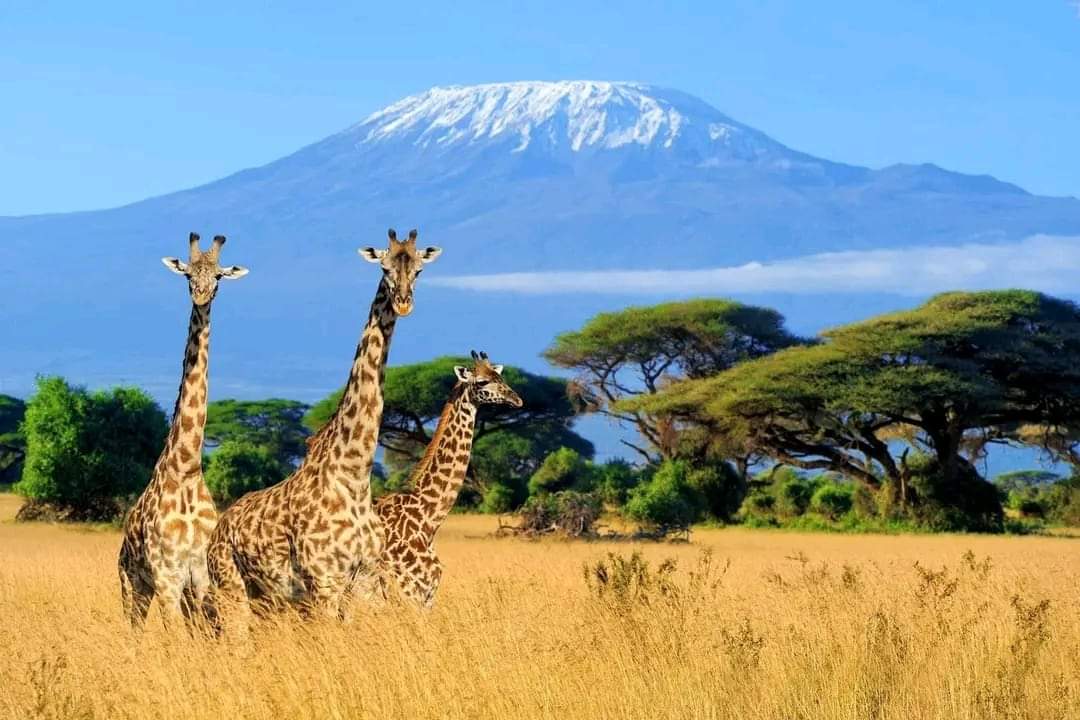
Mount Kilimanjaro is the highest mountain in Africa at 5,895 m, the highest free-standing mountain on Earth, and the only one of the Seven Summits that ordinary fit travellers can climb without ropes, crampons or technical alpine experience. Roughly 35,000 trekkers attempt the summit every year and around two-thirds reach Uhuru Peak. The mountain stands on its own on the Kenya–Tanzania border, rising 4,900 m from the surrounding plains in a single uninterrupted slope, with three volcanic cones (Kibo, Mawenzi, Shira) and five distinct climate zones from rainforest to arctic summit. The summit is one of the great life achievements: a sunrise from the crater rim, with the snow and glaciers around you, the curve of the Earth on the horizon and Africa stretching beneath, that nothing else in adventure travel quite matches.
The five major routes — and which to choose
Five established routes lead to Uhuru Peak. The Machame Route (south, 6–7 days) is the most popular and offers excellent acclimatisation and scenery. The Lemosho Route (west, 7–8 days) is widely considered the best — longest acclimatisation, most beautiful, highest success rates. The Marangu Route (east, 5–6 days) is the only hut-based route and the cheapest but has the lowest success rate due to short acclimatisation. The Rongai Route (north, 6–7 days) is the only northern approach, drier than the others and a good rainy-season option. The Umbwe Route (south, 5–6 days) is the steepest, most direct, hardest, and a serious climber's choice. For a first-time trekker the answer is almost always Lemosho 8-day, with Machame 7-day as the cost-conscious second choice.
Success rates by route and duration
Summit success rates are heavily correlated with the number of days on the mountain. KPAP (Kilimanjaro Porters Assistance Project) and Kilimanjaro National Park data: Marangu 5-day around 27%; Marangu 6-day around 45%; Machame 6-day around 45%; Machame 7-day around 65%; Lemosho 7-day around 75%; Lemosho 8-day around 90%. The lesson is unambiguous: more days = higher chance of summit. Operators selling 5- or 6-day climbs are selling a lower probability of success, not a budget version of the same product. Spend the extra two days. Above 4,000 m the body needs time to adjust to thinning air, and that adjustment cannot be rushed.
The five climate zones
Climbing Kilimanjaro is the experience of walking from the equator to the arctic in a week. Zone 1 (1,800–2,800 m) is the cultivated rainforest belt — coffee plantations, mosses, dense canopy, blue monkeys and colobus. Zone 2 (2,800–4,000 m) is the heath and moorland — giant lobelia, giant groundsel and the iconic Senecio kilimanjari plants found nowhere else. Zone 3 (4,000–5,000 m) is alpine desert — bare scree, freezing wind, almost no plant life, the volcanic landscape of Kibo's saddle. Zone 4 (5,000–5,895 m) is the arctic summit zone — glaciers, ice fields, sub-zero temperatures even at midday, the snows of Kilimanjaro. The transition from cloud forest at Day 1 to arctic glaciers at Day 6 is a journey through every climate Africa offers.
Best time to climb
Kilimanjaro has two dry seasons. January through early March is warmer, drier and the most popular climbing window. June through October is the cooler, busier high season — colder summit nights but excellent overall conditions. April–May (long rains) and November (short rains) are wet, slippery and best avoided. December has heavy crowds (Christmas/New Year) and unpredictable weather. The full-moon nights are the most spectacular for a summit attempt — you climb the final hours by moonlight rather than headtorch — but they also bring the biggest crowds. Plan your dates 6–9 months ahead to secure the best operator and avoid park-fee surcharges.
Cost and what's included
A reputable Kilimanjaro climb costs $2,200 to $4,500 per person depending on route, duration and operator standard. Inclusions: park fees ($800–1,200 alone, depending on route and days), camping/hut fees, professional mountain guide, assistant guides for groups, porters (typically 3 per climber), cook, all meals on the mountain, transfer to and from Moshi/Arusha, and hut/tent accommodation. Tips for the mountain crew (typically $250–350 per climber for the standard team) are extra. Bargain operators advertising sub-$1,500 climbs almost always cut corners on porter wages, food quality and safety equipment — climb with a KPAP-approved operator. The mountain has had fatalities in recent years and operator quality matters.
Fitness, training and what to pack
You don't need to be an athlete, but you do need to be in good aerobic condition. Train for 3–6 months before the climb: long hill walks with a 10 kg pack, stair climbing, jogging or cycling. Strength matters less than cardiovascular endurance and mental resilience. Critical kit: 4-season sleeping bag (rated to -10 °C), down jacket, hardshell waterproof jacket and trousers, fleece mid-layers, base layers, gaiters, broken-in waterproof boots, gloves (inner + outer), warm hat, sun hat, sunglasses (Cat 4 for the glacier), headtorch, water bottles (3 litres total capacity) and a daypack. Most kit can be hired in Moshi, but boots should be your own and well broken-in. Diamox is widely used for altitude — discuss with your doctor.
Combining Kilimanjaro with safari and beach
Most travellers combine Kilimanjaro with a Tanzanian safari and Zanzibar beach extension. The classic 14-day trip is: 7 days Kilimanjaro (Lemosho) + 4 days Tanzania safari (Tarangire, Manyara, Ngorongoro, Serengeti highlights) + 3 days Zanzibar. After 7 days at altitude, the wildlife and beach reward is hard to beat. From Moshi, the safari starts in Arusha (1.5 hours by road) and Zanzibar is a 1-hour flight from Arusha or Kilimanjaro Airport. The combined trip is the single best two-week itinerary in East Africa.
Practical info: visa, vaccines, getting there
Tanzania visa on arrival or e-visa ($50–100 USD depending on nationality). Yellow fever certificate required if arriving from a yellow-fever country (including Kenya — most trekkers transiting through Nairobi). Malaria prophylaxis essential below 2,500 m, not above. Travel insurance with high-altitude (above 6,000 m) cover and emergency evacuation is mandatory — check the policy small print. Fly into Kilimanjaro International Airport (JRO) directly (KLM, Qatar, Ethiopian, Kenya Airways) or via Nairobi (1-hour onward flight). Moshi town at the foot of the mountain is the gateway and where most pre-climb hotels are.